I blog about environmental and social justice issues because I am very concerned about the health of the interdependent web of life of which we are a part.

Melting Arctic ice.......beautiful and frightening!

Search This Blog

Tuesday, January 22, 2013

A New Economic Model

If you've ever thought that the way economists and accountants ignore "externalities" and consider it  beneficial  when we fire up  a new coal fired electrical plant on- line (more GDP good ! ), then you will be heartened to know some economists are thinking sustainably.
 

Conference Board Rates Canada

Apparently the Conference Board of Canada has been taken over by pinkos - or foreign radicals - or eco-terrorists. 

The Conference Board’s overarching goal is to measure quality of life for Canada and its peers. But a country must not only demonstrate a high quality of life—it must also demonstrate that its high quality of life is sustainable.   There is growing recognition that gross domestic product (GDP) produced at the expense of the global environment, and at the expense of scarce and finite physical resources, overstates the net contribution of that economic growth to a country’s prosperity. Canadians understand that protecting the environment from further damage is not a problem for tomorrow, but a challenge for today. Without serious attention to environmental sustainability, Canada puts its society and its quality of life at risk....Canada ranks 15th out of 17 peer countries and scores a “C” grade on its environmental performance report card. Canada’s poor record in several areas—including climate change, energy intensity, smog, and waste generation—drags down its comparative performance. Only Australia and the U.S. rank below Canada. http://www.conferenceboard.ca/hcp/details/environment.aspx
 

Greenhouse Gas (GHG) Emissions
Climate change is now the most serious global environmental threat.1 Its potential impacts include global warming, sea level rise, increased extreme weather events, and altered rainfall patterns. Climate change is a direct consequence of elevated greenhouse gas (GHG) concentrations in the atmosphere and feedback mechanisms. ..Canada is one of the world's largest per capita GHG emitters. Canada ranks 15th out of 17 OECD countries on GHG emissions per capita and scores a “D” grade...Despite international commitments to drastically reduce GHGs, Canada has not seen a substantial improvement on its per capita GHG emissions. 
http://www.conferenceboard.ca/hcp/details/environment/greenhouse-gas-emissions.aspx
 
Who needs to criticize  Canadian government policy when  the Conference Board is doing it for environmental activists?

Sunday, January 20, 2013

What Makes a Good Life

If my vision in the post below is correct; and we, the people, have a collective death wish; what should environmental activists do about this? 

How do we enhance a 'life wish' in the collective unconsciousness? 

If we each embrace life, will a complex system change?  Maybe......

Most of us don't perceive that we have a good life right now.  In fact, the Happy Planet Index, as calculated by the new economics foundation, reveals that most countries in the world are moving in the wrong direction: we are no happier in the developed world than in poorer nations, and yet we consume more and more of the world’s resources. http://www.neweconomics.org/publications/happy-planet-index

We seem to be  suffering from affluenza.

Proponents of the term consider that the prizing of endless increases in material wealth may lead to feelings of worthlessness and dissatisfaction rather than experiences of a 'better life', and that these symptoms may be usefully captured with the metaphor of a disease. They claim some or even many of those who become wealthy will find the economic success leaving them unfulfilled and hungry only for more wealth, finding that they are unable to get pleasure from the things they buy and that increasingly material things may come to dominate their time and thoughts to the detriment of personal relationships and to feelings of happiness. http://en.wikipedia.org/wiki/Affluenza

Clearly, something is very wrong with our lives as measured by the Happy Planet Index.  This isn't just an individual matter:  the cultures and societies we have made seem sick and dysfunctional. 
 
How do we embrace life? What makes a good life? How do we model that?

It seems to me that, on an individual basis, self - awareness  coupled with compassion; lots of social connections/  bonds; and lots of physical movement make up a good life for those of us with a place to live, enough to eat, and a job.   It also helps to have something to do/ work on that gives one's life meaning and purpose.   And that old fashioned value, self-restraint, seems to me a good one - particularly when thinking  about buying stuff!

On a national basis, a nation composed of individuals living a good life will have a collective  awareness of natural limits; a social safety net; status assigned by how compassionate we are (instead of by how much we consume) ; a physical structure that encourages us to walk, talk to our neighbours, catch transit, eat local,  a progressive income tax structure that narrows income inequality, and an estate tax to prevent the accumulation of wealth; free education; laws about truth in advertising to prevent tobacco companies from lying about their products; and beauty.

Will this work?  Maybe - maybe not.  Global catastrophe may be upon us: see http://rspb.royalsocietypublishing.org/content/280/1754/20122845.full.pdf  

 Modelling appropriate behaviour; revelling in life; and lobbying government and working for change are the best ideas I've got.

What are yours?

Self Hatred

I witnessed a soul retrieval healing for a friend in 2010. While my friend and the healer were journeying, the beat of the drum proved almost hypnotic. I wrote the following:

The healer suggested "outside, in nature find a stick...."
Are we not nature?
Not if we live in a linear world - a poverty stricken world without mess, change or growth.
And we do everything we can to destroy life and growth: spiders, bacteria, mice ....
We clean furiously,
lay traps,
sweep away cobwebs...
and we spray pesticides and weedkiller outside.
We detest life. We detest change.
We wish to end the cycle of life - death - life.
Oh - to be a machine......
We are not machines.
We are life. Stardust . Divinity. Energy.
We scintillate and shimmer and dance and coruscate and change and
die and are born once more.
From this we create balance.
We are ordered tension.
Crystals growing - decaying - shifting - changing.
When we prevent change we prevent life.
We wish to die - permanently.
That is why we try to kill Gaia.
We desire sterility.
Complete.
Utter.
Final.
END.
No change. When we achieve that, we too will be gone.
We want that. We hate ourselves.
If we learn to love ourselves, we will save the world.
She is a part of us - we are a part of her -we need her.
So -
when we are healed of self hatred, we will be healed of world hatred.

I've thought about this  - off and on - ever since.   Does the collective unconsciousness have a death wish?  Do we have a death wish?

Saturday, January 19, 2013

Amazon Degradation

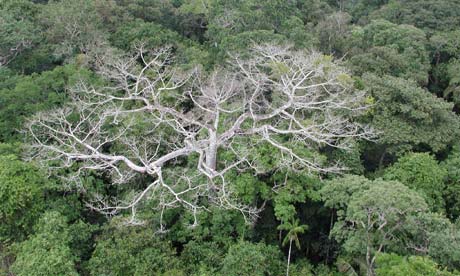
An area of the Amazon rainforest twice the size of California continues to suffer from the effects of a megadrought that began in 2005, finds a new NASA-led study. These results, together with observed recurrences of droughts every few years and associated damage to the forests in southern and western Amazonia in the past decade, suggest these rainforests may be showing the first signs of potential large-scale degradation due to climate change. ..."The biggest surprise for us was that the effects appeared to persist for years after the 2005 drought," said study co-author Yadvinder Malhi of the University of Oxford, United Amazon rainforest shows signs of degradation due to climate change says NASAKingdom. "We had expected the forest canopy to bounce back after a year with a new flush of leaf growth, but the damage appeared to persist right up to the subsequent drought in 2010." ...The researchers attribute the 2005 Amazonian drought to the long-term warming of tropical Atlantic sea surface temperatures. "In effect, the same climate phenomenon that helped form hurricanes Katrina and Rita along U.S. southern coasts in 2005 also likely caused the severe drought in southwest Amazonia," Saatchi said. "An extreme climate event caused the drought, which subsequently damaged the Amazonian trees."  http://www.nasa.gov/topics/earth/features/earth20130117.html
We cannot survive if we destroy our home.

The overall productivity of the biosphere is therefore limited by the rate at which plants convert solar energy (about 1 percent) into chemical energy and the subsequent efficiencies at which other organisms at higher trophic levels convert that stored energy into their own biomass (approximately 10 percent). Human-induced changes in net primary productivity in the parts of the biosphere that have the highest productivity, such as estuaries and tropical moist forests, are likely to have large effects on the overall biological productivity of the Earth.  http://www.britannica.com/EBchecked/topic/66191/biosphere/70861/The-importance-of-the-biosphere


Are we suicidal?  Consider the Alberta government's position.

Trains to Alaska. Pipelines to Churchill, Man. New refineries in Alberta. Oil shipments to Saint John. A step back from costly environmental rules. Alberta's government wants them all. http://www.theglobeandmail.com/globe-investor/alberta-scrambles-as-oil-pipelines-clogged-revenues-slashed/article7536306/


If we're not - if you're not - please  lobby your provincial and federal government.

We NEED to phase out fossil fuels! 

Friday, January 18, 2013

Ocean Acidity

Line graphs showing levels of dissolved carbon dioxide and pH measurements at three ocean stations from 1983 to 2011.
 cahttp://www.epa.gov/climatechange/science/indicators/oceans/acidity.htmlption


This figure shows the relationship between changes in ocean carbon dioxide levels (measured in the left column as a partial pressure—a common way of measuring the amount of a gas) and acidity (measured as pH in the right column). The data come from two observation stations in the North Atlantic Ocean (Canary Islands and Bermuda) and one in the Pacific (Hawaii). The up-and-down pattern shows the influence of seasonal variations.
http://www.epa.gov/climatechange/science/indicators/oceans/acidity.html
More proof that we're harming ourselves by not reducing greenhouse gas emissions.  Think it doesn't matter?  It does to these folks:

For four frustrating months in 2007, Mark Wiegardt and his wife, Sue Cudd, witnessed something unsettling at their Oregon oyster hatchery: tank bottoms littered with dead baby oysters...It turned out that "corrosive" seawater, which makes it harder for young oysters to build shells, was largely to blame. Like the atmosphere, the world's seas are burdened by our fossil fuel use and deforestation. The ocean has sponged up a quarter of the carbon dioxide humans have produced since the Industrial Revolution, steadily lowering its pH. Today's seas are 30 percent more acidic than their pre-industrial ancestors. http://www.hcn.org/issues/44.21/can-the-oyster-industry-survive-ocean-acidification/article_view?b_start:int=1


How  much proof do we need before denial cracks and we actually do something?    


Wednesday, January 16, 2013